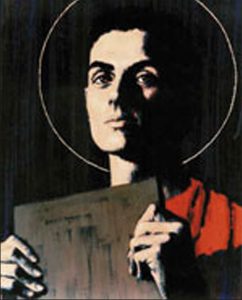
Although tradition often imagines Viator as a young man at the time of his departure for Egypt, historical facts do not allow for his exact age to be determined. While he was undoubtedly in the prime of life when leaving Lyon for the desert of Scetis, he remains an adult of uncertain age.
After more than 1,600 years, it is remarkable that we know so much about a man whose life was exceptional only for his holiness. This biographical sketch follows the traces left by Viator in history. To bring it to life, it is worth meditating on his faithfulness, his sense of service, and his spirit of prayer—values as essential in the 4th century as in the 21st for every disciple of Christ. Viator was a reader of the Church of Lyon, a disciple and faithful companion of Bishop Justus. He lived at the end of the 4th century and died around the year 390.
Viator’s life is inseparable from that of his bishop. Saint Justus, successor to Verissimus around 343, was a gentle, educated, and respected man. In 381, a tragic event disrupted his life: a man gripped by madness, after committing murders in the public square, took refuge in the cathedral. Despite the bishop’s intervention to guarantee a fair trial, the mob seized the culprit and lynched him. Deeply marked by this bloodshed which he had been unable to prevent, Justus felt unworthy of his office. Desirous of devoting the rest of his life to penance and contemplation, he decided to join the desert of Scetis, in Egypt.
Upon learning of his bishop’s secret departure for Marseille, Viator decided to join him to share his fate. Together, they embarked for Alexandria, then ventured into the Libyan desert to join the community of Saint Macarius of Egypt. His life there was marked by rigorous asceticism:
Although they kept their identities secret, a Lyonnais pilgrim recognized them a few years later. Despite the mission of Antiochus (future Bishop of Lyon) to convince them to return, the two men decided to remain faithful to their Egyptian solitude.
Bishop Justus died around 390, and Viator followed him to the grave shortly thereafter, no doubt weakened by grief and the rigors of the desert. Their bodies were brought back to Lyon around 399, arriving in the city on August 4. On September 2, their relics were solemnly transferred to the church of the Maccabees (which would later take the name Saint-Just). At that time, monastic life was honored just as much as martyrdom.
The cult of Saint Justus and his reader Viator became so important that it eclipsed that of the first Lyonnais martyrs, Pothinus and Irenaeus. In the 5th century, four feast days were dedicated to them:
In 1287, an official verification allowed for the finding of the two bodies in the same tomb, accompanied by documents on Viator’s holiness (now lost). Despite the destruction of the church by the Calvinists in 1562 and the desecrations of the French Revolution in 1793, the relics were saved on each occasion by the vigilance of the faithful and the sacristans, and today they rest in the new church of Saint-Just.