PROVINCE OF CANADA
Its beginnings – its expansion
In 1847, three courageous French confreres, supported by the Archbishop of Montreal, Bishop Ignace Bourget, implanted the Viatorian charism in L’Industrie (Joliette). The community experienced rapid growth, allowing it to send confreres to the four corners of the country, mainly in the provinces of Quebec, Ontario, and Manitoba. Then, our brothers were drawn to mission throughout the world. The province thus implanted the charism in the United States, China, Taiwan, Japan, Peru, Haiti, and finally Burkina Faso. Several confreres also collaborated with the international organizations of the community and supported works in France and Ivory Coast.
Upheavals
The 1960s brought a true earthquake for the Church in Quebec and religious communities. The “Quiet Revolution” saw the state take over educational and hospital establishments, social services, and leisure activities. Slowly, the community decreased in the number of confreres and places of insertion. Today, the province is responsible for the local communities of Japan and Peru and the two regions of Burkina Faso and Haiti.
Mode of operation
The Province of Canada is animated by a provincial council composed of three members: Br. Jean-Marc St-Jacques, Provincial Superior, Fr. Gérard Bernatchez, Assistant Provincial, Br. Yvon Rolland, Councilor. Ten confreres, elected by all religious, form the Provincial Chapter along with the Provincial Council and the Provincial Treasurer. For its part, the Assembly of the Viatorian Community brings together all religious and associates of Canada. It has established a council composed of the members of the provincial council and three associates elected by the assembly: Hernio Carrié, Lorraine Decelles, and Annie Perreault. Its mandate is to support spiritual life, mission, and fraternal communion.
The works and commitments of the Viatorians
Several Viatorians have personal commitments in various places: schools, parishes and diocesan services, movements and camps, accompaniment of individuals, presence to the impoverished, support of community groups, etc. This is a precious contribution to the Church and society.
Canadian Viatorians are responsible for two parishes: Ste-Béatrice in Laval (Diocese of Montreal) and Ste-Madeleine de Rigaud (Diocese of Valleyfield).
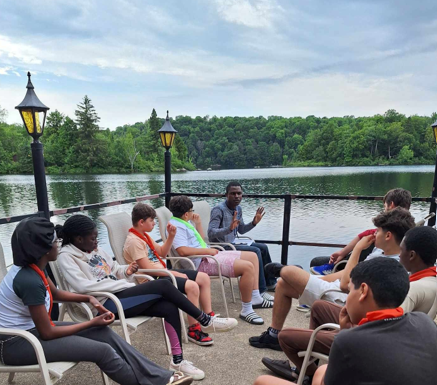
In the summer of 2024, the Service de Préparation à la Vie (SPV) marked the 60th anniversary of its founding, and in the summer of 2025, it was the turn of the Camps de l’Avenir (Lake Ouimet) to do the same. These two organizations offer an education in fraternity in the manner of the first Christians (Acts of the Apostles 2:42-47). The SPV continues its presence in Quebec and elsewhere in the world (Haiti, Peru, Burkina Faso, Ivory Coast, Cameroon, Togo, DR Congo, Madagascar, Uganda). Several religious and associates are involved in these two works here in Quebec, but also in Haiti, Peru, Burkina Faso, and Ivory Coast.
The Maison de la foi at the service of the deaf world is intended for people with hearing loss, but also for practitioners in this particular field. Pastoral activities and celebrations are at the heart of its action. A soup kitchen, “Marie-Paule’s Soup,” regularly brings together about twenty people in search of food, but especially fraternal exchange.
The Viatorian Catechetical Service continues its offer of services in all simplicity. It is still consulted by many people and produces various documents to support the training of catechists.
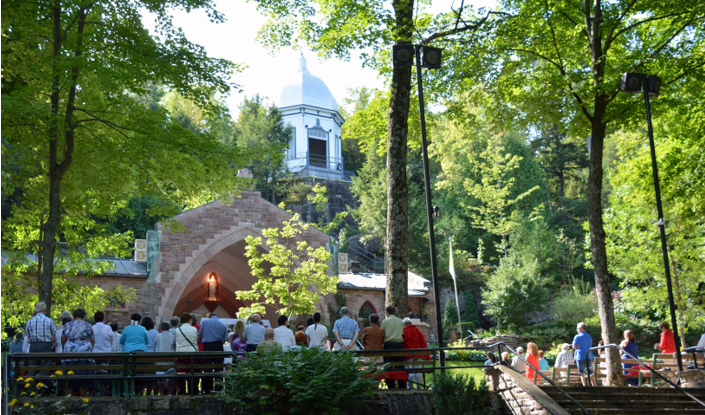
The Sanctuary of Lourdes celebrated its 150th anniversary throughout the 2024 season. It continues to welcome thousands of pilgrims every summer.